
Before I joined Aidin, I spent years leading hospital care coordination at BayCare Health System, overseeing care coordination across ten acute care hospitals at one point. So when a group of case management leaders sat down to compare notes on what actually makes a post-acute network perform, the conversation felt familiar — I’d lived a lot of it myself.
The health systems getting the best results aren’t relying on relationships alone. They have built programs for objectivity, visibility, and shared accountability. Here’s what stood out most from that discussion, and what it takes to build a post-acute network that holds up under pressure.
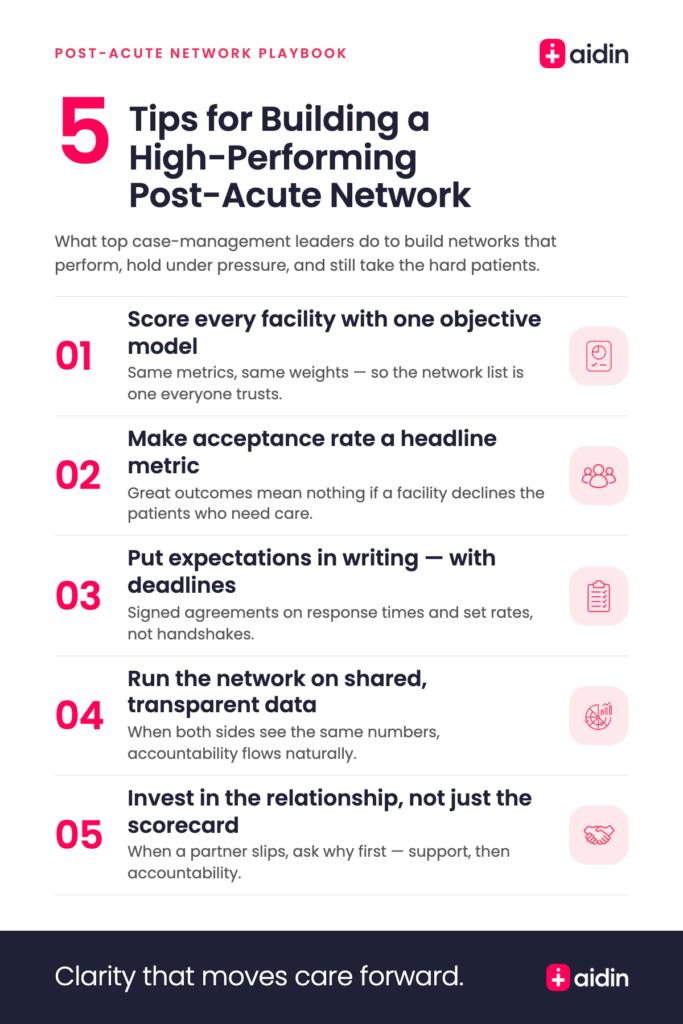
1. Score every facility with the same objective model
The most common failure mode isn’t picking the wrong facilities. It’s picking them for inconsistent reasons. One facility makes the network for its length of stay, another for its star rating, another for low readmissions. When the criteria aren’t consistent, frontline case managers stop trusting the list.
One case management executive at a multi-hospital health system described the fix: “We created this tool where every single metric is attached to a score, and the aggregate score determines whether you’re in the network. The goal was that everyone can agree this is a fair assessment of the facilities.”
An example of a successful model scores CMS star ratings, readmissions, length of stay, referral turnaround time, acceptance rate, the average readmission risk of accepted cases, and a “citizenship” survey completed by frontline case management and population health teams. The top scorers make the high-performing PAC network, and everyone can see why.
2. Make acceptance rate a headline metric
Quality metrics alone reward cherry-picking. A facility can post excellent outcomes by simply declining every complex patient, which does nothing for throughput — or for the patients who need that care most.
“You can have the best metrics in the world, but if you only take one out of 100 patients, you’re doing me no good,” said one VP of case management, who added acceptance rate to her network scorecard using referral data from Aidin. “We expect you to take a certain percentage of our patients.”
Leaders recommend pairing acceptance rate with the average acuity or readmission risk of accepted cases. Together, they show whether a partner is truly performing, or just selecting their way to good numbers.
3. Put expectations in writing — with real deadlines
The highest-performing networks run on signed agreements, not handshakes.
Case management leaders described contracts requiring 24-hour admissions, referral response deadlines, and pre-negotiated rates for single-case agreements, which help everyone align upfront on expectations and costs.
Those set rates changed the economics of hard placements overnight. “It was a game changer,” one leader shared. “We don’t have to negotiate on every patient. You’re in our high-performing network, you signed this contract, we’re sending you this patient, and we’re going to pay you this amount.”
Deadlines work the same way. “We said 24 hours, and now we’re at 18. Some of our hospitals give SNFs four hours,” another leader explained. “Give them tighter deadlines, because that’s what really changes it. Hold your team accountable — but also be reasonable with those post-acute partners.”
4. Run the network on shared, transparent data
Accountability conversations go better when both sides are looking at the same numbers. Health system leaders described scorecards built on time-stamped referral data such as response times, acceptance trends, and disposition changes, shared openly with post-acute partners.
“When you have clear expectations and visibility, the accountability part flows naturally,” one care management director said of her system’s experience with Aidin. “When you’re going to have conversations, it’s not about frustrations — it’s about data.”
One system used disposition-change reporting to shrink a system-wide problem into a manageable one: instead of handing leaders 207 referrals to investigate, the data pointed to the three specific cases driving excess days. “It’s not handing them 207 and saying go figure it out. It’s: here’s three.”
5. Invest in the relationship, not just the scorecard
Networks that perform over years pair accountability with genuine support. Leaders described twice-yearly collaborative breakfasts with network facilities, quarterly joint operating committees, and post-acute coordinators who sit in on SNF utilization review meetings.
When a partner underperforms, the first question is why. “Early on, it’s: maybe they don’t understand it. Maybe it’s an opportunity to re-educate that team,” one leader said, describing how a re-education effort at a network facility improved its scores without a single punitive conversation.
Geography matters too. In rural markets with few options, leaders described a pragmatic approach: rather than holding out for facilities that meet urban-market standards, partner with the best available facilities and actively help them improve — because your patients are going there anyway.
The common thread: visibility and shared accountability
None of these five practices requires more staff. They require a shared, objective view of how every referral, response, and placement actually happens — the visibility that makes fair scorecards, enforceable expectations, and productive partner conversations possible.
That’s the role Aidin plays for 200+ hospitals: real-time referral data across every post-acute partner, so acceptance rates, response times, and disposition changes are visible to everyone working the problem. Across health systems using Aidin, 85% of patients are placed with top-quality post-acute providers (versus 16% nationally), contributing to an average 0.86-day reduction in length of stay in year one.
A high-performing network isn’t built by finding perfect partners. It’s built by making performance visible, expectations explicit, and accountability shared.
Want to see how your post-acute network is actually performing? Our team would love to walk you through the data — and where these practices could reduce LOS, improve placements, and cut rework for your teams. Get in touch here.
About the Author:
Lindsey North, MS, RN-BC, Senior Director, Client Success, Aidin
At her core, Lindsey North is a case manager helping other case managers — drawing on her own experience on the front lines to help teams drive results, streamline their work, and get patients to the right care faster.
She leads Client Success at Aidin, partnering with health systems to turn real-time care transition data into measurable gains in length of stay, capacity, and post-acute network performance. Before joining Aidin, Lindsey spent 15 years in hospital care coordination, most recently as Regional Director of Care Coordination at BayCare Health System, where she oversaw hospital care coordination across 10 acute care hospitals at one point and served as a subject matter expert on the health system’s EMR implementation.
She has authored articles for ANPD and ACMA, designed and taught several courses across BayCare — including a charge nurse education series — and is an active ACMA member and Daisy Nurse Leader award recipient. She holds a Bachelor of Health Science Education from the University of Florida and both a Bachelor and Master of Nursing from the University of South Florida.
